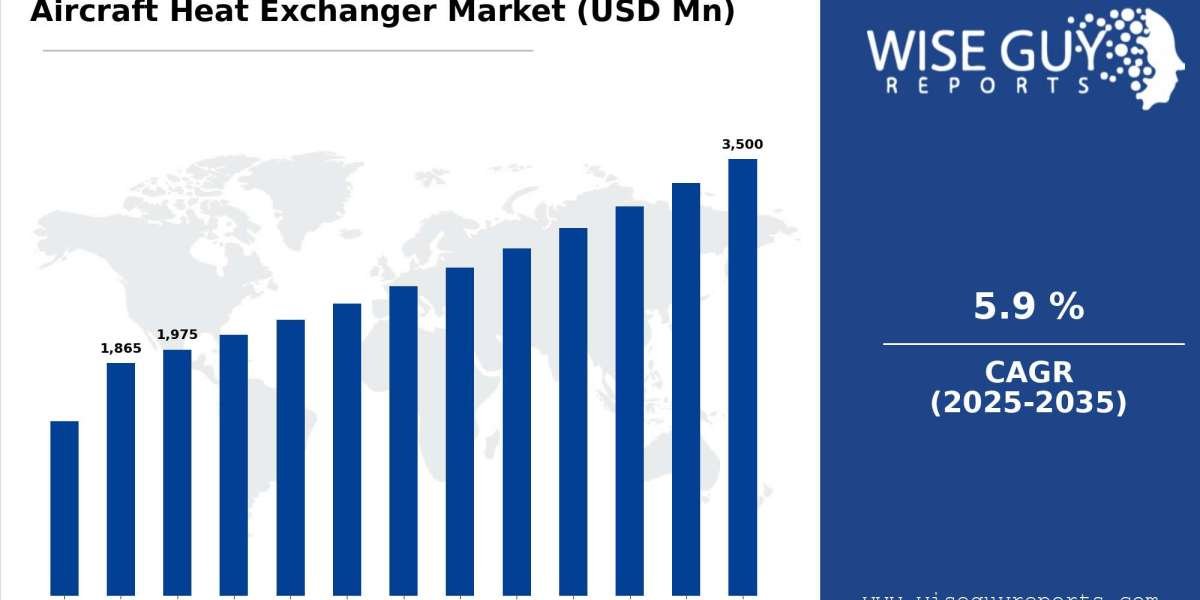

The Aircraft Heat Exchanger Market is an essential segment of the broader aerospace industry, addressing critical thermal management needs across multiple aircraft systems. Market research shows that the Aircraft Heat Exchanger Market is expected to grow from 1,974.7 USD Million in 2025 to 3,500 USD Million by 2035. The Aircraft Heat Exchanger Market CAGR (growth rate) is expected to be around 5.9% during the forecast period (2025 - 2035).
Heat exchangers are indispensable to aircraft, regulating temperatures in engines, environmental control systems (ECS), fuel conditioning systems, hydraulic cooling loops, and avionics. With the aviation market’s increasing emphasis on efficiency, reliability, and sustainability, the demand for optimized heat exchange solutions continues to gain traction.
One prominent industry trend in the Aircraft Heat Exchanger Market is the rise of lightweight and high-efficiency materials. Aluminum alloys dominate due to their excellent strength-to-weight ratio and cost competitiveness, particularly for commercial airliners and narrow-body aircraft. However, increasing adoption of titanium is expected, as its high corrosion resistance and thermal tolerance make it ideal for extreme-temperature environments such as engines and high-performance military aircraft.
Design innovation is also driving the market. Plate-fin heat exchangers, known for their compact size and superior heat transfer capabilities, are widely adopted for both commercial and defense applications. Their lightweight and efficient thermal management properties position them as key growth drivers, particularly for advanced propulsion systems and next-generation aircraft platforms.
Another market trend involves the integration of heat exchangers in next-generation propulsion architectures, including hybrid-electric and hydrogen-powered engines. These propulsion systems generate complex thermal profiles that must be managed without adding excessive weight, making efficient heat exchanger design critical. As aerospace manufacturers push toward cleaner and more sustainable flight technologies, heat exchangers play a pivotal role in achieving thermal stability and performance goals.
Regional dynamics play a significant role in shaping the market share and growth of aircraft heat exchanger systems. North America holds a leading position, driven by its established aerospace manufacturing base, heavy investment in R&D, and the presence of major industry players. The region’s aerospace ecosystem supports continuous innovations in thermal management technologies, making it the dominant market for both commercial and military aircraft applications.
The Asia-Pacific region is expected to exhibit robust growth over the forecast period due to rapid expansion in commercial aviation, government investment in aerospace infrastructure, and growth in defense aerospace programs. Nations like China and India are increasing aircraft production and focusing on advanced air mobility solutions, which demand effective thermal management systems, thereby boosting local market development.
Europe continues to maintain a significant market share, supported by innovation hubs in countries such as Germany, France, and the United Kingdom. European aerospace manufacturers prioritize lightweight design, fuel efficiency, and compliance with stringent environmental regulations, all of which enhance the demand for advanced heat exchangers.
From an industry analysis standpoint, key players are investing in technologies that improve heat exchanger efficiency while reducing overall aircraft weight. This includes advanced material alloys, novel manufacturing techniques like additive manufacturing, and improved fin geometry designs that increase thermal performance without drastically increasing component size.
Strategic partnerships between OEMs and specialized suppliers are also shaping the future of the market. Collaborations aimed at co-developing thermal management solutions for electric aircraft and unmanned aerial vehicles (UAVs) are becoming more common. These alliances enable companies to share expertise and innovate faster in a highly competitive environment.
In conclusion, the aircraft heat exchanger market is positioned for sustained expansion as aviation continues to evolve toward greener, lighter, and more efficient technologies. Advances in materials, thermal design, and cross-industry collaborations are expected to fuel innovation and drive growth through 2035.